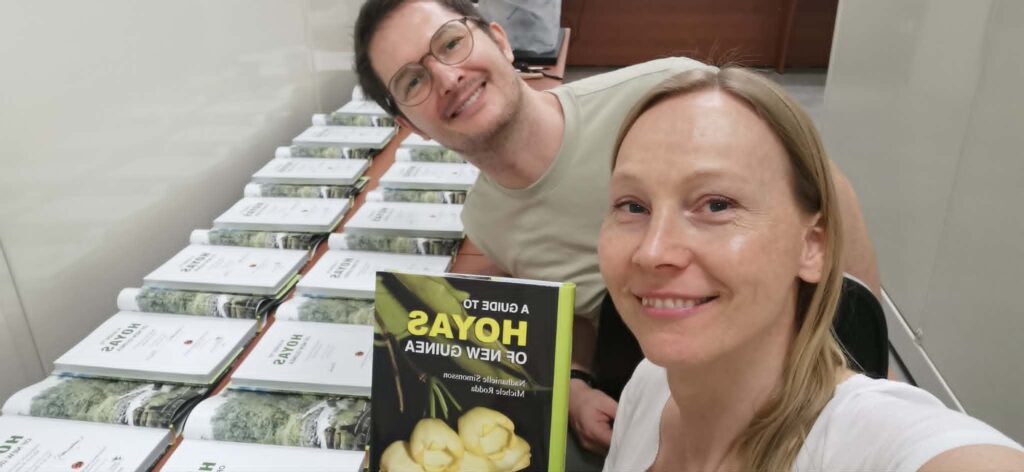
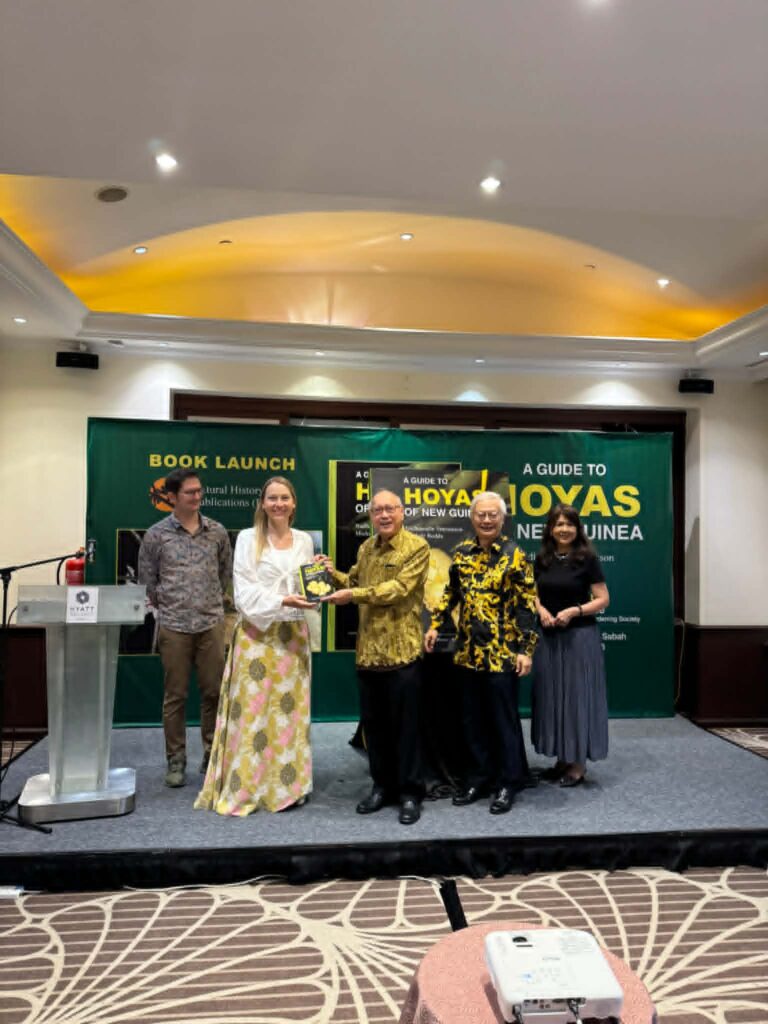
Hoya enthusiasts have been waiting for it for years. After nearly two decades of research in some of the world’s most inaccessible rainforests, Nathalie Simonsson and Michele Rodda have published A Guide to Hoya of New Guinea – the most comprehensive overview to date of the fascinating wax plants that grow on the island where new species continue to be discovered at a remarkable pace.
The collaboration between Michele Rodda, Research Fellow at the Singapore Botanic Gardens, and Swedish botanist and explorer Nathalie Simonsson dates back nearly twenty years. They were introduced in 2006 by Torill Nyhuus, former president of the Swedish Hoya Society and former editor of the Hoya Telegraph.
“Nathalie first travelled to Papua New Guinea in 2008 and moved there in 2010. She lived there for six years, until 2016,” Rodda says.
Those years in the field resulted in an exceptionally rich body of material documenting New Guinea’s Hoya flora. Drawing on Simonsson’s extensive collections and observations, the two authors gradually built what would eventually become the foundation of the new book.
“A few years ago, we published two major scientific papers – one describing ten new species and another describing nine. Over time, we accumulated such a large amount of information that it eventually became this book,” Rodda explains.
While Simonsson contributed much of the field material, plant collections, and observations from her years in New Guinea, Rodda focused on compiling and verifying the information.
“Nathalie provided much of the primary material. My role was mainly to bring everything together, examine herbarium specimens, review the literature, and make sure all the information was accurate and up to date.”
Rodda himself has visited New Guinea only once, during a trip to Papua New Guinea in 2017.
“That feels quite a long time ago now. Without Nathalie’s many years of fieldwork and collections, this book would never have been possible.”
Transforming years of research into a finished book proved to be a lengthy process.
“The material was there, but proofreading, checking photographs, verifying herbarium specimens, and making sure everything was accurate takes a great deal of time,” Rodda explains.
The decisive final push came only last year.
“Our publisher, Mr. Chan Chew Lun, deserves a great deal of credit. He encouraged me – kindly but persistently – to finish the book. It also would not have been possible without the support of Mr. Tan Jiew Hoe from Singapore,” Rodda says.
For Nathalie Simonsson, the publication marks the end of a long and, at times, challenging journey.
“New species are being discovered all the time, the pandemic delayed part of the work, and we also wanted to wait for more photographs of rare species as they came into flower,” she says.
“Our goal has been to create a comprehensive overview of the wax plants of New Guinea and the surrounding regions.”
The Most Comprehensive Guide Yet
The book covers 67 species and five subspecies, combining botanical descriptions with an extensive photographic collection gathered over many years of exploration.
Readers will find habitat descriptions, conservation assessments, and historical accounts of Hoya exploration in the region dating back to the early nineteenth century. The guide also highlights species from a wide range of ecological zones, from coastal rainforests to mountain habitats above 2,600 metres.
Among the most notable species are the widespread Hoya coronaria complex, Hoya australis – which ranges from Borneo to Polynesia – and Hoya nicholsoniae, whose distribution extends as far as New Caledonia and Polynesia.
The book also highlights several remarkable New Guinean endemics (meaning they occur nowhere else on Earth), including montane species such as Hoya krusenstierniana, Hoya magnifica, and Hoya juhoneweana ssp. lindforsiana, as well as lowland species including Hoya globulifera, Hoya archboldiana, and Hoya ischnopus.
A Centre of Biodiversity
New Guinea is one of the world’s most important centres of diversity for the genus Hoya. According to the book, approximately 86 percent of the region’s species are endemic.
The guide also introduces readers to Papuahoya, a genus separated from Hoya that is found exclusively in New Guinea, including species such as Papuahoya urniflora and Papuahoya bykulleana.
The authors emphasise that documenting this biodiversity is becoming increasingly important as primary forests come under growing pressure from logging, mining, and land conversion.
“But the book is also about giving something back. We are foreign researchers who have worked in their country, and it feels important that this knowledge is also shared with the people who live there. I hope the book can serve as a practical resource for those working with these plants locally,” Simonsson says.
She believes the guide can play an important role not only in research and conservation but also in preserving knowledge of species that may face increasing threats in the future.
More Than a Book for Collectors
The book is intended for a broad audience, Simonsson says.
“I hope people will enjoy the beautiful photographs and learn more about these plants.”
At the same time, she stresses its scientific foundation.
“Our publisher has a scientific profile, so this is not a popular science book. It is a scholarly reference work.”
For researchers, it fills an important gap. Many species are known only from herbarium specimens, which often provide limited information about variation, flower colour, or preferred growing conditions. By combining field observations, living collections, and extensive photographic documentation, the authors have been able to present a much richer picture of the region’s Hoya diversity.
The guide also showcases the astonishing diversity within the genus. As the authors point out, New Guinea’s Hoyas exhibit at least eight distinct corolla forms, leaves ranging from just a few millimetres to more than twenty centimetres in length, and an extraordinary variety of colours, textures, and growth habits.
Despite the many years devoted to the project, Rodda hopes the book will soon need updating. He points to the experience of A Guide to Hoyas of Borneo, published around ten years ago.
“That book is already badly out of date. Many new species have been discovered since then, and several previously known species have been rediscovered.”
The same development is expected in New Guinea, one of the world’s richest yet least explored botanical regions.
“I hope this book also becomes outdated very quickly,” Rodda says. “A great deal of new material is being collected, and within two or three years another ten or twenty new species may well have been described.”
Text: Aleksandra Pogorzelska
Editor’s note: This article is an excerpt from Hoyatelegrafen No. 1 (2026), which will be published later this year.